General study information
What is the study about?
“Futures Of AI-Impacted Teaching and Learning: Perceptions and Imaginaries from Students: A Pilot Project” is a multi-university study of how higher education students think, feel, and make sense of their generation’s use of Generative AI (GenAI) in higher education, and how they perceive the impact of these technologies on the changing future of higher education amidst rapid and often radical institutional responses. The study seeks to collect in-depth qualitative accounts of students’ lived experiences and perspectives, in the form of audio, text, or video narratives gathered through a DIY auto-ethnography. In doing so, it contributes rich and urgently needed detail to augment existing data, primarily gathered by survey or at small scales, related to student use. It simultaneously fosters critical AI literacies for student participants, by inviting them to reflect on their roles in GenAI-impacted teaching and learning contexts. Just as importantly, this pilot study amplifies student voices and, in turn, urges institutions, disciplines, and educators to take those voices into account as they respond to the ongoing GenAI crisis in higher education.The study is centered around:
Understanding Usage Patterns: How are students in a range of disciplines and universities using GenAI in their education activities? Perceptions and Awareness: What do students think about their own use of GenAI in higher education and how aware are they of its implications and wider use among their peers? Future-Oriented Perspectives: How do students feel about the current transformations in higher education in relation to the possible experiences of future student generations? Amplifying Student Voices: How can we bring student voices more directly into recent shifts in higher education around the integration and ethics of GenAI in classrooms? Fostering Reflexive AI Literacies: How can researchers foster reflexive AI literacies among higher education students by engaging them as co-researchers focused on exploring how their own practices with GenAI are disrupting and reshaping the possible futures of higher education?Research team
- Dr. Annette Markham
- Dr. Lachlan Robb
- Dr. Taina Bucher
- Dr. Riccardo Pronzato
- Ana Kubrusly
Methodology
We use the methodological framework of guided autoethnography developed over many years by Markham (2012-2021), whereby young adults conduct autoethnographic studies of their own digital lived experiences. This method enables students to dive into questions in their own time/space, and has been proven to produce rich and meaningful narrative introspection. The basic steps include obtaining willing participants through self-selection, giving them instructions to conduct self-oriented participant observations and to keep field diaries, where they follow and respond to a list of suggested open-ended interview questions provided by researchers. The participants then donate their data to the project, either through their instructor or directly to the international pool of data (depending on whether the student participates as part of a class or not and how much the instructor wants to be involved). In this way, we collect participants’ audio or text diaries. This data is transformed to text, de-identified/anonymized, analyzed, and then shared. The outcome may be a data repository, a presentation of common themes, a showcase of vignettes, etc.
Study Design – Guided Autoethnography + Grounded Theory
The study combines guided autoethnography and grounded theory to explore students’ lived experiences with GenAI. Participating students engage in self-oriented observation and self-interviewing to build rich, reflective narratives.Sampling and Recruitment
We seek a broad range of perspectives, so the sample is unrestricted, beyond the limitation that participants should be current Bachelor, Masters, or PhD students at universities. Participants are recruited through snowball sampling. Invitations may be shared by teachers, through flyers, or via social media. Students not participating in a course can volunteer directly. Interested students will receive detailed information about the study in advance. Participants receive this letter and also have the opportunity to ask questions to ensure they are well-informed and comfortable with their decision to participate.Self-Guided Study
After familiarizing themselves with the basic procedures for participating in this 1-week DIY self-study, participants will then choose whether they want to take part. They will also receive some basic facts about how student use of GenAI is causing higher education institutions to rapidly and sometimes radically respond to what many call a “GenAI Crisis.” These changes include new policies, major as well as minor curriculum adjustments, and evolving teaching and learning environments. Participants will also receive a series of questions to reflect on and instructions about how to write or record a research diary for self-study. The questions basically invite students to reflect on their own and others’ uses of GenAI, their feelings about its current and future roles, their imaginaries of what higher education might or should become in the age of GenAI, and how these transformations may affect future generations of learners. Over 3 days, 1 week, 2 weeks, or 3 weeks, they will create and then submit short written and/or audio reflections inspired by these prompts, similar to research diaries or fieldnotes.Data Protection
Within the “Futures of AI-Impacted Teaching and Learning” study, we work with personal data, i.e., information that says something about you. This might include your name or address, as well as your self-directed diary responses to our questions.
What personal data do we collect?
We collect the following personal data from participants: Name and email address – to be able to send you instructions for how to conduct the self-study; so you can register for the data donation system; and to respond to you if you send an email to ask questions. Your voice, through audio recordings – this is collected only if you choose to send audio files as a file format for your self-study diaries. This is not required, but many participants find it easier to create and submit audio diaries. Written texts – if you elect to send text files as a file format for your self-study diaries. Transcripts of your contributions – we will convert audio recordings into readable text that can be analyzed.What happens to participants’ personal data?
Name and email address: We will store this temporarily. If we need to communicate with you, this is used. Once you donate your data to us, and we transform your identifiable data into an anonymous form to remove any incidental personal data from your contribution, we’ll delete your email messages and your email address. This will happen no later than three months after we have prepared the data donations adequately for analysis. The data donation system will collect your email address to enable you to log in with a username and password. This information is secure and not shared. Once the data collection is completed and the raw data files are transcribed into texts and ready for analysis, we will delete your email address from the system. Your Voice data: If we receive audio files from you, we store these temporarily in the secured folder into which you uploaded these files. We then transcribe audio into text-only documents and permanently destroy the voice recording. This deletion will happen no later than six months after we have prepared the data donations adequately for analysis. We then anonymize the transcribed texts, as described below Your Text data: Once we receive your text files, and text transcripts of any audio files you might have donated (see above) we transfer them to a different file format, which strips the original metadata in the file, which may contain personal data. We then go through the files to remove or anonymize all the remaining personal data, as this is not needed for our analysis. This might include changing any mention of your own name or mention of friends’ and family members’ names to generic labels such as ‘participant’, ‘friend’, or ‘other person mentioned’; removing phone numbers; removing any other metadata or information that could link your data donation to your personal identity. We assign your folder an identifier number. This means that if you donated 3 files, each would have the same identifying number to make sure these files remain somehow connected to each other (P1.1, P1.2,P1.3 to indicate Participant-1-file-1, Participant-1-file-2, Participant-1-file-3, and so forth.). This is important for our analysis. Once this is done, for us, it's impossible to tell whose mail address is linked to any identifying number. Tip: we suggest you refrain from making any reference to your or others’ names, name derivatives, or identities. Be assured, we will remove this information as it is not needed for our analysis.How and where is the data stored?
We store these transcribed files on secured university servers and analyze them: Your originally submitted data files are securely stored in original form on a secured Utrecht University server. This data is accessible by password by the primary researcher and the data manager who will conduct the transformation and cleanup process from original audio/text to its transcribed and anonymized form. Once the anonymized transcription has been verified for accuracy, these originally submitted data files will be permanently deleted, no later than six months after you have donated this data. The anonymized transcripts of all participants’ contributions will be held for ten years, will be made available to the research team and may be put into a repository for other researchers to use. The complete dataset is archived on Yoda or SURF, both well-secured systems at Utrecht University.Who has access to your data?
Only the primary researcher and a data manager/transcription assistant have access to your personal data. These members are obliged to keep your data confidential. Once the dataset is cleaned and anonymized, it may be made available to other researchers.We ensure proper security of your personal data
Utrecht University treats your personal data very confidentially. We secure your data well. For example, all computers that hold personal data are password protected, and many computers are even more secure, with a second “factor” (2-factor authentication, or 2FA).Are we allowed to use your personal data?
One of the tasks of Utrecht University is to conduct scientific research. This is a task of public interest, which is why we are allowed to use your personal data. Did you participate in this study? If you do not want us to use your personal data, you can object. Please contact the researcher (a.n.markham@uu.nl) or fill out the Privacy Request Form at https://forms.uu.nl/universiteitutrecht/formulier_privacy_verzoek (Dutch only). Please include the title of the study, the name of the researcher and the reference number: XXX. We will then see if the study causes you any harm. If so, we will delete your data. Please note! You can only object if we can find out which personal data belongs to you. Once your personal data has been anonymized, you can no longer object.What rights do you have under the GDPR?
People whose personal data we use have a variety of rights. For example, they may access their personal data. In case you notice that certain information is not correct, you sometimes have the right to have those data corrected. In addition, you can ask us to delete your personal data; however, this is subject to strict conditions. Would you like to exercise your rights? Please contact the researcher (a.n.markham@uu.nl) or fill out the Privacy Request Form at https://forms.uu.nl/universiteitutrecht/formulier_privacy_verzoek (Dutch only). Please include the name of the study, the name of the researcher and the reference number: XXX. Please note! You can only exercise the above rights if we can find out which personal data belongs to you. Once your personal data has been anonymized, you can no longer exercise the above rights. You also have the right to file a complaint. To do so, please contact our privacy department (privacy@uu.nl) or our data protection officer (fg@uu.nl). If you are unable to reach an agreement with us, you can file a complaint with the Dutch Personal Data Authority (the Autoriteit Persoonsgegevens).Teachers Click Here
Below you’ll find detailed information on different aspects:
Choose your level of involvement
There are multiple ways to conduct this research, here is a short overview:
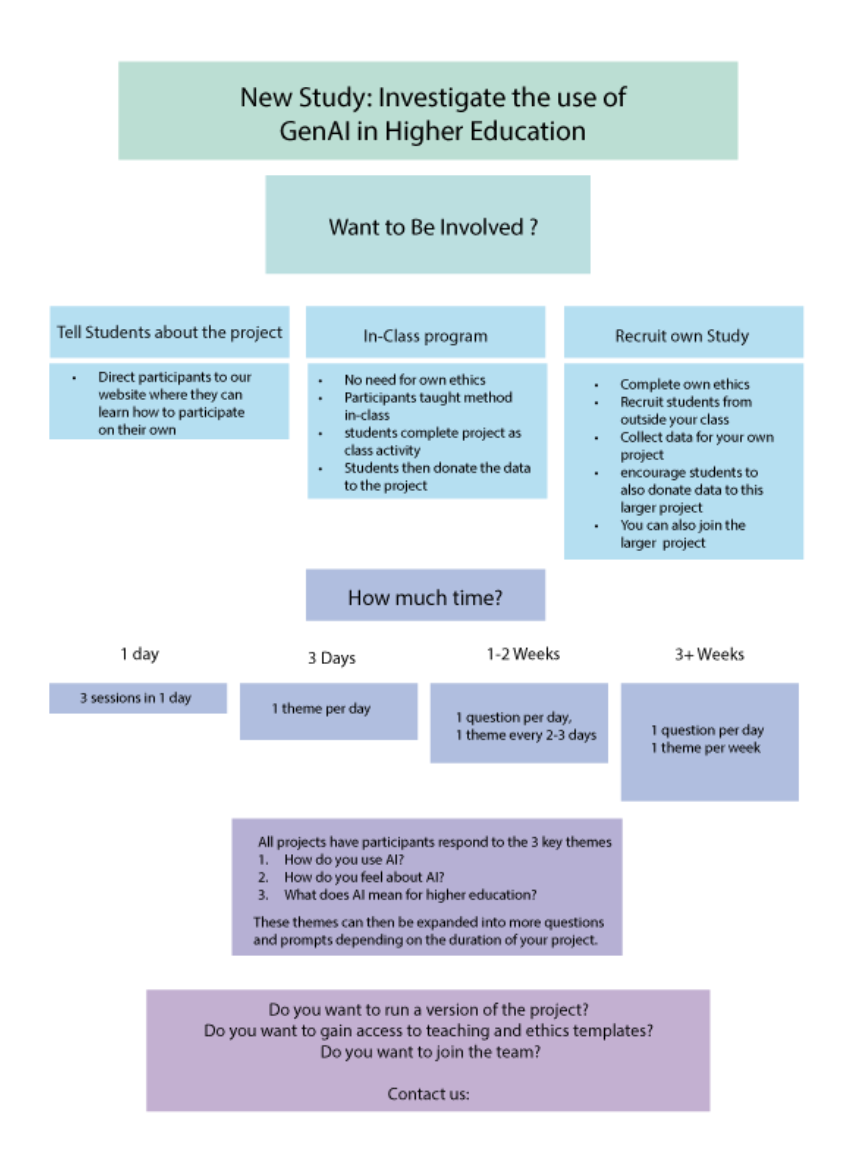
How to run the study in your classroom
Information missing
Prompts
3 days
missing information
1 Week
add Ana Pop Stefanija’s model
21 days
Add Lachlan’s model
FAQ
Ethics and Clearances
Has this study received formal ethics approval?
Yes. The study has been approved by the ethics committee of Utrecht University.
Who is the principal researcher and the responsible Institution?
The principal researcher is Annette Markham. The study is hosted by Institute for Cultural Inquiry (ICON) at Utrecht University.
Is participation voluntary for students?
Yes, participation is fully voluntary. The information provided to students makes it clear that participation is unrelated to coursework or grades. We ask teachers not to incentivize, reward or pressure students to participate, and not to track who in their classes has joined.
Could students disclose academic misconduct in their diaries (e.g. unauthorized AI use)?
Yes, this is a realistic possibility. To ensure students’ safety and encourage honesty, the diary content is held confidential by the research team, anonymized before analysis, and never shared with universities, teachers, or administrators. Any disclosure by students will not be used against them.
Can students withdraw?
Yes, students can withdraw during the data collection period until their data has been anonymized, since afterwards their data cannot be matched anymore. Withdrawal requests during that time period result in full deletion of their contributions. There are no consequences for withdrawing.
How is informed consent obtained?
Missing information
Who do I contact for ethical questions?
Is there a general e-mail? Or a.n.markham@uu.nl
Data Donation Portal
What is the portal?
The portal is a custom-built, GDPR-compliant data donation interface hosted on UU servers within the EU. It allows participants to upload written and audio reflections. (Based on ethics approval, accurate?)
How do students access it?
Students register with an e-mail address and create a password-protected account. The account credentials are stored separately from the diary content itself, so the research team analyzing the entries does not see who submitted what.
Who can I contact when students ask me technical questions about the portal?
Missing information
Data Use and Protection
Who has access to participants’ data?
Only the primary research team has access to the data.
How is the data anonymized?
Audio is transcribed to text. All text documents are stripped of names, institutions, course names or codes, and identifying details of students, teachers or peers before analysis.
How long is the data stored?
Original audio and text files will be deleted after they are transcribed and anonymized. The resulting clean data, without any identifying details, will be stored for 10 years and might be made available to other researchers upon request.
Where is the data stored?
Missing information
Who can I contact about questions about data use and protection?
Missing information
Students Click Here
Section three details
Choose the length of your autoethnography
You can follow different lengths of this study:
Basics of doing DIY autoethnography
About the Study
Student use of GenAI is pushing universities to respond fast — sometimes radically — to what many are calling a “GenAI Crisis.” New policies, curriculum changes, and shifting classroom norms are happening all around you. This study invites you to reflect on what that means for you and for the students who come after.
During the study you’ll receive:
- A set of reflection prompts to guide your thinking
- Instructions for keeping a research diary (written, audio, or both)
The prompts ask you to think about things like: how you and your peers actually use GenAI, how you feel about its role now and in the future, what higher education could or should look like in the age of GenAI, and what these changes might mean for future generations of learners.
Over three days, one week, or 21 days, you’ll create short reflections inspired by these prompts — think of them as fieldnotes or diary entries, not polished essays.
Sharing Your Reflections
You’ll upload your written and/or audio diaries through a secure, custom-built interface. To use it, you’ll register with your email and create a password — you’ll log back in each time you submit a new entry. The platform is GDPR-compliant and purpose-built for voluntary data contributions, so your uploads stay protected.
What Happens with Your Data
Audio files will be transcribed to text, and any personal information will be removed before analysis begins. The research team will then use thematic analysis to look for patterns and insights across everyone’s contributions.
Prompts to guide you through the study
3 days
missing information
1 Week
add Ana Pop Stefanija’s model
21 days
Add Lachlan’s model
FAQ
Ethical Protection
Is participation voluntary?
Yes, completely. You decide whether to join, and you can stop at any point without giving a reason. Choosing not to take part, or pulling out partway through, won’t affect your studies or grades in any way.
Can my teachers or university see what I submit?
No. Your reflections go directly to the research team through a secure platform and will be anonymized. None of your teachers, advisors or administrators will have access to your diary entries.
What if I admit to using AI in ways my university doesn’t allow?
Your reflections will not be shared with your university and cannot be used against you. The point of the study is to understand honest, real-world GenAI use among students. Your honesty is what makes the research valuable.
What if I mention other people (classmates, teachers, friends) in my diary?
Try to avoid using identifying details where possible. If you do mention someone, the research team will remove names and identifying information during anonymization, before any analysis.
Has this study been ethically reviewed?
Yes, this study has been reviewed and approved by the ethics committee of Utrecht University. This means an independent ethics committee has checked that the research design doesn’t risk your wellbeing, privacy and autonomy.
Who do I contact with questions or concerns?
Is there a general e-mail? Or a.n.markham@uu.nl
Data Donation Portal
How do I sign up?
Go to (XXX) / You’ve been given a link to a registration page. Register using your e-mail address. You’ll create a password during signup. Use the same login each time you submit a new diary entry.
What can I upload?
You can type your reflections directly, upload a text file, or record audio on your phone or computer and upload that. You can also mix formats across different entries. Accepted file formats are XXX.
How long should each entry be?
There is no minimum or maximum. A few sentences is fine, so is a longer voice memo. Take the space you need but try to aim for honesty over polished answers.
What if I forget my password?
Missing information
Who can I contact if I have technical issues?
Missing information
Data Use and Protection
Who can see my diary entries?
Only the primary research team. No one else, including your university, has access to your raw data.
Will my name or identity appear anywhere?
No. Before analysis, all personal information (names, places, course names, anything that could identify you or another person) will be removed. When findings are published, you cannot be identified from any quotes or examples used.
Will my words be quoted in publications?
Possibly. Short, anonymized quotes might appear in academic articles, conference talks, or reports. All identifying details will be removed before publishing.
Will my audio recordings be shared?
No. Audio is transcribed to text before analysis, and the original audio files are then deleted. Only the anonymized text is used in analysis.
How long is my data kept?
Original audio and text files will be deleted after they are transcribed and anonymized. The resulting clean data, without any identifying details, will be stored for 10 years and might be made available to other researchers upon request.
Where is my data stored?
Missing information
Will my data be used to train AI systems?
Missing information